Wings (1927)
0Tuesday, 8 May 2012 by owlish
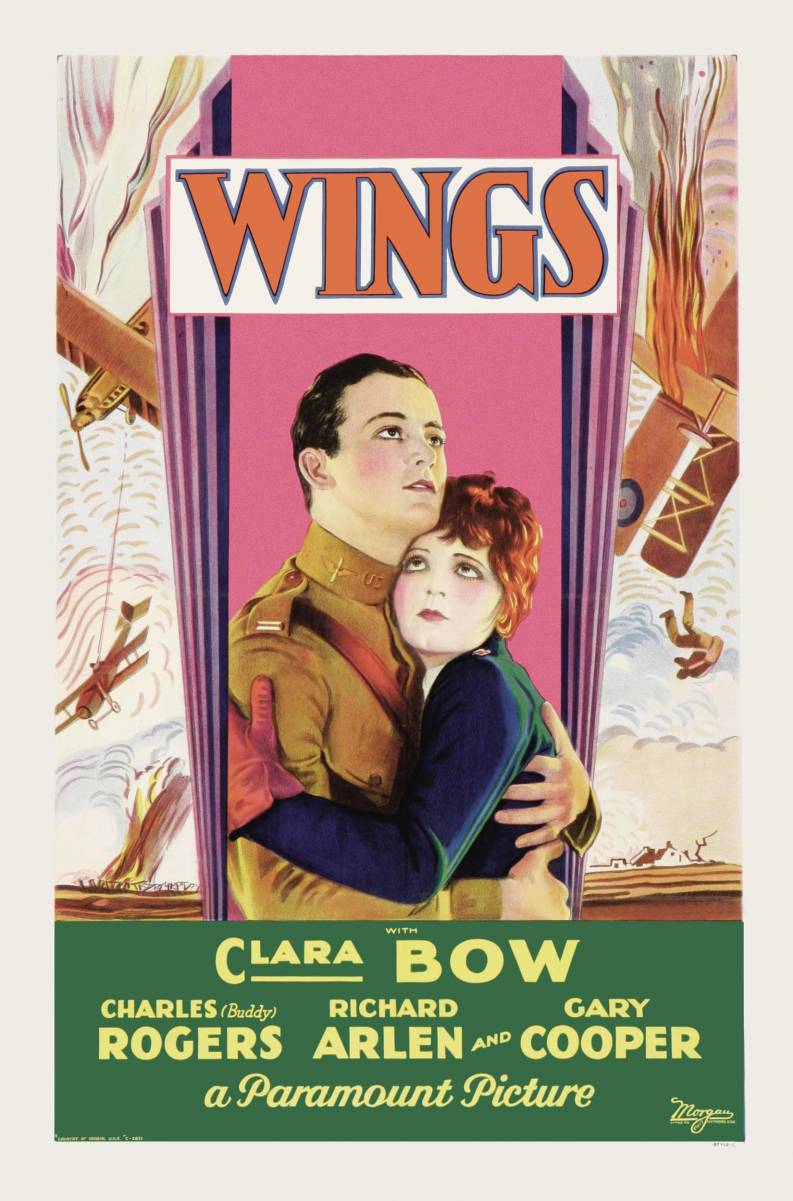
A Paramount Famous Lasky Corporation
Production, distributed by Paramount Pictures.
Wings
(1927) is a pretty significant film historically. It’s the first ever Best
Picture winner and, prior to this year, was the only silent film to ever win
that same Oscar. It features the first same-sex kiss on film and is one of the
first films to show nudity (this being Clara Bow’s rather lovely top half). In
this way, it’s a remarkable piece of cinema.
The story
though is not exceptional. It’s about two young men’s journey into becoming
fighter pilots during the First World War. There’s a subplot or two – mostly
romantic. The two men are competing initially over the same woman, Sylvia
(Jobyna Ralston), and through a mishap she ends up declaring herself to the
wrong one, Jack (Charles ‘Buddy’ Rogers), instead of the one she actually
loves, David (Richard Arlen). At the same time, Jack’s neighbour, Mary (played
wonderfully by original ‘it-girl’, Clara Bow) struggles with getting Jack to
see her romantically, and ends up following him out to war as an ambulance
driver.
The first
thing to know about Wings is that
it’s a long film. It stands at almost
two and a half hours and feels every bit as long as that. There’s a scene
mid-way through where Jack gets pretty wasted and the film kind of goes on a
tangent about bubbles. It’s weird (I mean,
really). The film as well seems to jump between exceptionally sombre
melodrama, slapstick and long fight scenes, in other words, a lot of chest
clutching and a lot of mishaps – including the aforementioned topless Clara Bow
scene which, whilst you don’t actually see a whole lot of anything (at least
not by today’s standards), feels like a direct draw on her sex-symbol status.

For me
though, the film’s remarkabilities stem from some solid performances by Bow and
Arlen and a wonderful cameo from a future movie star in Gary Cooper, but mostly
with the production values of the film. At 84 years old, the flight scenes are
still impressive, the cinematography expansive and the battles tense.
I didn’t love this film, honestly. There were parts of it I loved
– Mary’s decision to enter the war and then rescuing Jack from expulsion at her
own expense was great, the climactic flight scenes were exciting and David and
Jack’s reunion at the end is moving to say the very least. That said, there are
a lot of other things happening. The love triangle (square?) feels tacked on,
with next to no closure happening with poor Sylvia (who is grossly underused),
the male-bonding is drawn out and the film is just long and doesn’t necessarily always manage to keep you there with
it. It’s a solid film though, and as the original Oscar winner, it’s worth the
watch.
Rating: 7/10
Director:
William A. Wellman
Writers:
John Monk Saunders, Hope Loring & Louis D. Lighton
Producer:
BP Schulberg
Cast:
Clara Bow, Charles ‘Buddy’ Rogers & Richard Arlen
Nominations: Best Effects, engineering effects (winner)
& Best Picture, Production (winner)
Category 1927, 7, BW, Drama, Nomination:Best Effects, Nomination:Best Picture, Oscars01, Silent, Won:Best Effects, Won:Best Picture, WWI

A Ship Comes In (1928)
0Friday, 4 May 2012 by owlish
A Ship Comes
In (1928)
A DeMille
Pictures Corporation Film, Distributed by Pathé Exchange.
A Ship Comes
In (1928) is a heartfelt film about
a Hungarian, immigrant family rehoming themselves in America. The film has a
heavy hand in themes of patriotism, longing, grief and reinvention, and
explores all of these discourses against the backdrop of New York during the
First World War.
The story begins with a ship harbouring in
New York, ushering in the immigrants as ‘hopeful strangers’. We meet Peter
Pleznik (Rudolph Schildkraut), his wife, referred to only as ‘Mama’ (Louise
Dresser) and their three children, Eric (Milton Holmes), Marthe (Linda Landi)
and Katinka (Virginia Davis & Evelyn Mills). They move into an apartment
and Peter gets a job as a janitor in a federal building. After five years,
Peter is sworn in as an American citizen, something he has immensely desired,
only to be framed for an act of terrorism intended for a Judge with whom Peter
has formed a friendship. On the same day, the Pleznik’s eldest son enlists in
the army for the First World War.
The film itself is actually kind of tedious,
with lengthy scenes, unsympathetic characters and a plot that doesn’t so much
thicken as ramble. Having said that, performances across the board are pretty
solid. Rudolph Schildkraut gives a strong performance as the wistful and proud
Peter and Louise Dresser also gives an emotional performance as Mrs. Pleznik, a
woman defined by the traditional life roles of motherhood and wifedom. (Dresser
actually has some of the most expressive eyes I’ve seen in cinema).
Though thematically, the film is still
incredibly relevant, the narrative itself hasn’t really aged well and whilst the
scope of themes such as terrorism, patriotism and a sense of home are explored
admirably, the film itself is a bit of a drag.
Rating: 5/10
Director: William K. Howard
Writers: Sonya Levien & Julien Josephson
Cast: Rudolph Schildkraut, Louise Dresser &
Milton Holmes
Nominations: Best Actress in a Leading Role – Louise
Dresser
Category 1928, 5, BW, Domestic, Drama, Immigration, Nomination:Best Actress, Oscars01, Silent
About Me

- owlish
- Sophie Overett is a 22-year-old writer from Brisbane, Australia. She has a propensity for thermal singlets, white wine and making bios sound like terrible dating profiles. Her work has been published in Voiceworks and Writing Queensland. She’s also a fortnightly online columnist for Lip Mag where she writes about representations of women on TV. She has two cats and a blog. You should probably check out that last one.