RSS Feed

Showing posts with label Drama. Show all posts

Tempest (1928)

0

Tuesday, 5 June 2012 by


Tempest (1928)
A Joseph M. Schenck Productions Film. Distributed by United Artists.

Ivan Markov (John Barrymore) is a peasant soldier under Bolshevik reign. His dream is to reach the rank of officer, something he achieves in the first half of the film amidst a display of ability (the words excellent and perfect are used pretty frequently). It’s as a part of this that he meets Princess Tamara (Camilla Horn), the royal daughter of the Czar he serves. What begins as infatuation very quickly turns into obsession as Tamara spurns him and Markov aggressively pursues. The film is classified as a romance, but in many ways, it watches more as some sort of sexual thriller.

The first thing to know about this film is that the script is really not very good. It’s full of convenient and blatant plot devices, coincidences and really stunted dialogue. The second thing to know is that it has lady-issues. A part of me says 1928, but none of the other films I have seen so far have had this exact sense of woman as commodity. Not just that, but the film devotes a good forty minutes to justifying Markov’s behaviour (which is all in all pretty sexual predator), like it’s a-okay that he violates Tamara’s boundaries, space and privacy. He forcefully kisses her, invades her bedroom (and her bed), touches her things and the script tells us this is okay too because she’s infatuated right on back (she just doesn’t know it).

There’s a part of me that thinks, in the hands of a better writer, you could have a really interesting film. Markov’s obsession with rank could make a seamless transition to his obsession with the princess. He’s reached officer and, by being infatuated with Tamara, it’s another way of climbing up a social ladder and a society that disparaged him for so long. That said, I think that would be a very different film than what this one was trying to be.

So thematically the film isn’t good, but it does have some pretty great elements. The performances are generally solid, Barrymore continues to have an excellent profile and honestly, the location and the costumes all hit it out of the park, so if nothing else, it’s worth the watch for that alone. The birthday party in particular is wonderfully shot, from the dancers to watching the events through the glass. Camilla Horn also wears some pretty ace dresses as the princess and later as a sort of political refugee.

Rating: 6 / 10

Director: Sam Taylor
Writers: George Marion Jr. & Vladimir Nemirovich-Danchenko
Cast: John Barrymore, Camilla Horn & Louis Wolheim

Nominations: Best Art Direction (won)


Sunrise: A Song of Two Humans (1927)

0

Tuesday, 22 May 2012 by

Sunrise: A Song of Two Humans (1927)
A Fox Film Corporation Film. Distributed by  Fox Film Corporation.

Largely thought to be the greatest silent film ever made, Sunrise: A Song of Two Humans is a masterwork of cinema. It relies almost entirely on the visual and uses this to produce a beautiful work of expressionism. Ultimately a story of redemption, the film focuses on a country man who, after becoming infatuated with a woman from the city, intends to murder his wife. The husband, played by George O’Brien, realises his error, but only after the first attempt on his wife’s life.

The story itself is pretty melodramatic, but director F.W. Murnau does a wonderful job offsetting that by infusing the film with a real undercurrent of malice. There’s an anger to it from the start, a lot of that coming from the city woman, and it’s a representation of cinema generally on how this film shapes your mood. You feel for both man and wife – you feel his rage and her betrayal and then the tenderness of the relearned love. O’Brien’s grief towards the end swinging back around to a newly-directed malice, bringing the film to a great narrative cycle.

This is helped in part to some pretty exceptional performances. Janet Gaynor and O’Brien between them are given no lines of dialogue at all, so there’s a lot riding on the expression within their faces and movements, and both do sterling jobs of this. . Gaynor in particular gives a wonderfully harrowed and broken performance as the wife. Margaret Livingston too is strong as the manipulative and deceitful city woman, and the way she moves is so interesting – almost like a huntsman spider, and the implications of that alone is pretty wonderful.

That being said, the hero of Sunrise is the cinematography. Visually, this film is sublime.  The landscape shots and the use of shadow is as close to flawless as you can get with cinema, and the mobility of the camera work lends not to jerky hand-held shots, but instead to beautiful tracking of characters. Not only that, but the layering to define motive and express character thought is so clever and interesting and lends so much to the narrative and development of character. See what I mean at the caps below.

All in all, it’s pretty hard to fault this film, and it’s one that everyone should watch if they get the chance.

Rating: 10 / 10

Director: F.W. Murnau
Writers: Herman Suderman, Carl Mayer
Cast: George O’Brien, Janet Gaynor & Margaret Livingston

Nominations: Unique & Artistic Production (winner), Best Actress in a Leading Role (winner), Cinematography (winner), Art Direction


Sadie Thompson (1928)

0

Thursday, 17 May 2012 by

Sadie Thompson (1928)
A Gloria Swanson Pictures Film. Distributed by United Artists.

Sadie Thompson was a bit of a revelation for me. I went in with little knowledge of the film, bar a flimsy familiarity of the concept (one which is really quite dated). Sadie Thompson, played spectacularly by Gloria Swanson, a woman of questionable background, arrives on the island of Pago-Pago to start a new life. As a base for military men, Sadie enjoys the attentions until local extremist missionary, Davidson, played by Lionel Barrymore, takes issue with it. He lashes out at her with a little too much relish, in a desperate attempt to send her back to San Francisco. It all culminates into a series of pretty intense confrontations.

There’s a lot to like about this film. It deals with some controversial issues for the time – particularly corruption in the church which, at the time, was a pretty big no-no cinematically. Male dominance, patriarchy and controlled sexuality are also portrayed in a negative light. This is done particularly through Davidson’s extreme efforts to quash Sadie, but also in the effect it has on the slew of strong supporting characters, particularly Dr. McPhail (Charles Lane) and Sergeant Tim O’Hara (Raoul Walsh).

The film is held up by some pretty wonderful performances. Gloria Swanson as the title character is a powerhouse performer. She’s alternately flirty, seductive, feisty, angry and vulnerable (plus she has a pretty awesome swagger). She’s a total star in this film and steals every scene she’s in.

Lionel Barrymore as Davidson is great too. He plays a man who’s really on the edge, a missionary with old values in a new world, and Sadie’s provocation (intentional and not) pushes him over it. He becomes crazed, taking a little too much pleasure in his pursuit and then condemnation of Sadie. There’s a stand-out moment where he forces her to kneel in front of him which lends itself to a sexual charge from Barrymore’s Davidson. It’s both beautifully enacted, and really pretty creepy.

The whole film is beautifully shot too, with some wonderful uses of shadow and angles that works together with a pretty compelling script. The film is silent, so dialogue is done only through title cards, but, compared to other films I’ve watched so far, it relies in no small part on lip reading from the audience. Mostly in the fact that Swanson as Sadie swears quite a bit through the film, but as it wasn’t on the title cards, it didn’t affect the censorship during the release.

Unfortunately, the last 8-minute reel of the film is now lost, but the restoration company did a pretty good job piecing it together with remade title cards and stills from the film. You do lose some of the dramatic impact though, because the climactic confrontation is lost. That being said, I could write essays on this film. It’s wonderful and has so much happening for it that makes it feel ahead of its time. It’s a highlight for me from this year.

Rating: 8 / 10

Director: Raoul Walsh
Writers: W. Somerset Maugham & Raoul Walsh
Cast: Lionel Barrymore, Blanch Friderici, Charles Lane & Gloria Swanson

Nominations: Best Actress in a Leading Role & Best Cinematography


The Crowd (1928)

0

Thursday, 10 May 2012 by

The Crowd (1928)
A Metro-Goldwyn-Mayer (MGM) Film. Distributed by Metro-Goldwyn-Mayer.

This was actually the first film I watched from this year’s Oscars, and I guess was in some ways the film that started me off on this whole thing. It was probably a good thing all in all too – The Crowd is largely regarded as one of the triumphs of silent cinema and, watching it back now, it really still stacks up.

The film wastes no time introducing us to John Sims, who we watch grow from infant to boy to man. As a boy, his father praises him without restraint, telling him that he’ll be something in life, whilst John preens under the praise and yet shows little skill at anything in particular. John’s father dies abruptly when John’s a boy, and the film flashes forwards to John as a young man moving to the city, equally idealistic and full of self-importance. He meets and marries Mary in the space of a few days, and together they have two children whilst John works at a menial job without promotion or recognition.

The film’s focus lies in John, but also in Mary, covering milestones across their lives together and the unravelling of his character from ambitious, big-dreamed and egocentric to ultimately another lost soul in a big city. It’s interesting because for a film pushing 85, it’s thematically still totally relevant. John’s desire to separate himself from the masses and his expectation that this would come to him without ever having to work for it is hugely reflective of society in any age. It embodies the average developed-world man who grows up being told he’s special only to realise, ultimately, that he’s not. Of course it’s not just that. The film is a study in loss and grief, of the turbulence of a marriage built on unsteady foundations; it’s about shifting self-image and changing self-worth, and in all of these ways thematically it succeeds.

It’s melodramatic, sure, but it’s got a lot going for it that kind of lets you forgive that. The cinematography for one is gorgeous and photographic; the performances all wonderful, and the score (created in 1981 by composer, Carl Davis) does wonderful things at capturing the shifting moods of the film. This one is definitely worth the watch.

Rating: 8.5 / 10

Director: King Vidor
Writers: King Vidor & John V.A. Weaver
Cast: Eleanor Boardman, James Murray & Bert Roach

Nominations: Best Director, Dramatic Picture & Best Picture, Unique & Artistic Production.


Wings (1927)

0

Tuesday, 8 May 2012 by

Wings (1927)
A Paramount Famous Lasky Corporation Production, distributed by Paramount Pictures.

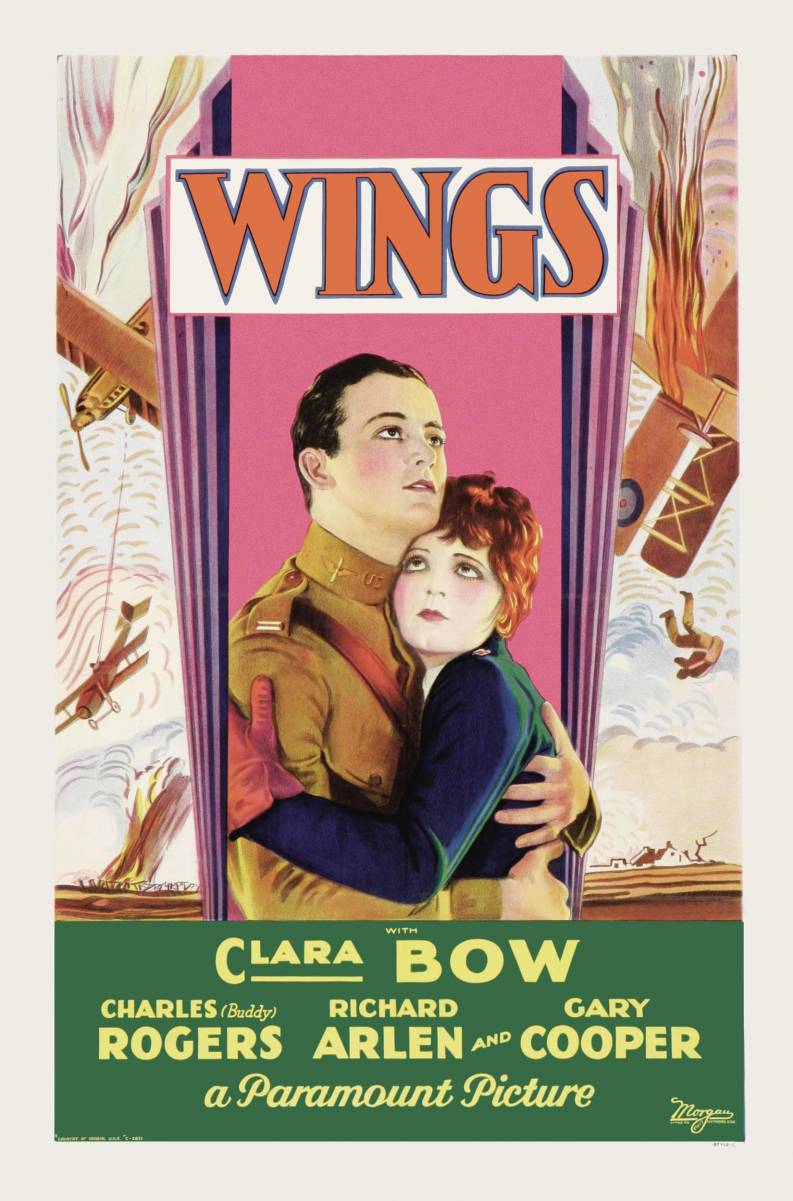
Wings (1927) is a pretty significant film historically. It’s the first ever Best Picture winner and, prior to this year, was the only silent film to ever win that same Oscar. It features the first same-sex kiss on film and is one of the first films to show nudity (this being Clara Bow’s rather lovely top half). In this way, it’s a remarkable piece of cinema.

The story though is not exceptional. It’s about two young men’s journey into becoming fighter pilots during the First World War. There’s a subplot or two – mostly romantic. The two men are competing initially over the same woman, Sylvia (Jobyna Ralston), and through a mishap she ends up declaring herself to the wrong one, Jack (Charles ‘Buddy’ Rogers), instead of the one she actually loves, David (Richard Arlen). At the same time, Jack’s neighbour, Mary (played wonderfully by original ‘it-girl’, Clara Bow) struggles with getting Jack to see her romantically, and ends up following him out to war as an ambulance driver.

The first thing to know about Wings is that it’s a long film. It stands at almost two and a half hours and feels every bit as long as that. There’s a scene mid-way through where Jack gets pretty wasted and the film kind of goes on a tangent about bubbles. It’s weird (I mean, really).  The film as well seems to jump between exceptionally sombre melodrama, slapstick and long fight scenes, in other words, a lot of chest clutching and a lot of mishaps – including the aforementioned topless Clara Bow scene which, whilst you don’t actually see a whole lot of anything (at least not by today’s standards), feels like a direct draw on her sex-symbol status.

For me though, the film’s remarkabilities stem from some solid performances by Bow and Arlen and a wonderful cameo from a future movie star in Gary Cooper, but mostly with the production values of the film. At 84 years old, the flight scenes are still impressive, the cinematography expansive and the battles tense.

I didn’t love this film, honestly. There were parts of it I loved – Mary’s decision to enter the war and then rescuing Jack from expulsion at her own expense was great, the climactic flight scenes were exciting and David and Jack’s reunion at the end is moving to say the very least. That said, there are a lot of other things happening. The love triangle (square?) feels tacked on, with next to no closure happening with poor Sylvia (who is grossly underused), the male-bonding is drawn out and the film is just long and doesn’t necessarily always manage to keep you there with it. It’s a solid film though, and as the original Oscar winner, it’s worth the watch.

Rating: 7/10

Director: William A. Wellman
Writers: John Monk Saunders, Hope Loring & Louis D. Lighton
Producer: BP Schulberg
Cast: Clara Bow, Charles ‘Buddy’ Rogers & Richard Arlen

Nominations: Best Effects, engineering effects (winner) & Best Picture, Production (winner)


A Ship Comes In (1928)

0

Friday, 4 May 2012 by

A Ship Comes In (1928)
A DeMille Pictures Corporation Film, Distributed by Pathé Exchange.

A Ship Comes In (1928) is a heartfelt film about a Hungarian, immigrant family rehoming themselves in America. The film has a heavy hand in themes of patriotism, longing, grief and reinvention, and explores all of these discourses against the backdrop of New York during the First World War.

The story begins with a ship harbouring in New York, ushering in the immigrants as ‘hopeful strangers’. We meet Peter Pleznik (Rudolph Schildkraut), his wife, referred to only as ‘Mama’ (Louise Dresser) and their three children, Eric (Milton Holmes), Marthe (Linda Landi) and Katinka (Virginia Davis & Evelyn Mills). They move into an apartment and Peter gets a job as a janitor in a federal building. After five years, Peter is sworn in as an American citizen, something he has immensely desired, only to be framed for an act of terrorism intended for a Judge with whom Peter has formed a friendship. On the same day, the Pleznik’s eldest son enlists in the army for the First World War.

The film itself is actually kind of tedious, with lengthy scenes, unsympathetic characters and a plot that doesn’t so much thicken as ramble. Having said that, performances across the board are pretty solid. Rudolph Schildkraut gives a strong performance as the wistful and proud Peter and Louise Dresser also gives an emotional performance as Mrs. Pleznik, a woman defined by the traditional life roles of motherhood and wifedom. (Dresser actually has some of the most expressive eyes I’ve seen in cinema).

Though thematically, the film is still incredibly relevant, the narrative itself hasn’t really aged well and whilst the scope of themes such as terrorism, patriotism and a sense of home are explored admirably, the film itself is a bit of a drag.

Rating: 5/10

Director: William K. Howard
Writers: Sonya Levien & Julien Josephson
Cast: Rudolph Schildkraut, Louise Dresser & Milton Holmes

Nominations: Best Actress in a Leading Role – Louise Dresser


About Me

My photo
Sophie Overett is a 22-year-old writer from Brisbane, Australia. She has a propensity for thermal singlets, white wine and making bios sound like terrible dating profiles. Her work has been published in Voiceworks and Writing Queensland. She’s also a fortnightly online columnist for Lip Mag where she writes about representations of women on TV. She has two cats and a blog. You should probably check out that last one.
Powered by Blogger.