Showing posts with label 1927. Show all posts
7th Heaven (1927)
0Tuesday, 29 May 2012 by owlish

7th
Heaven (1927)
A Fox Film
Corporation Film. Distributed by Fox Film Corporation.
7th
Heaven really swept up at the first
Oscars. It was nominated for the most awards, and won three out of five of
them. It’s interesting, because the film is very much a
romance, with any other genre really sitting on the bench. That’s not to say it
isn’t a great film, because it is.
Diane (Janet Gaynor) and her sister are
prostitutes, living in a slum-like apartment in an unnamed city. After an
incident goes pear-shaped with a wealthy relative, Diane’s tyrannical sister
tries to kill her. Diane is rescued by Chico, a sewer-worker who dreams of
becoming a street cleaner. He takes her in, and, after being mistaken for a
couple and Chico receiving a promotion as a result, the pair decide to live
together to reap the benefits of their fake marriage – one being Diane’s
assumed protection, and the second being Chico’s new job. In true cinematic conventions,
here begins a pretty sweet love story as the two fall for each other in spite
of social standing, war and tragedy.
The film is wonderfully directed by Frank
Borzage, and the cinematography is really world-building and all-encompassing
(keep an eye out for some of the staircase scenes and the rooftop one early in
the film – at the risk of sounding horribly cliché, both are visual feasts). Janet
Gaynor and Charles Farrell are kind of glorious together as Diane and Chico.
The chemistry is tangible and when they fall in love, you believe it, which is
a feat for a film in any age. Plus, as a couple aesthetically, they look great
(I mean, really, speaking of visual feasts).
Farrell is strong as Chico too – he walks a
fine line between charming and obnoxious, but always manages to fall on the
best side of it. That said, Gaynor is the star of this film, as she is in Sunrise – she builds a character that’s
blossoming under Chico’s kindness. Her fragility at the start of the film, a
battered woman, is so beautifully portrayed, which makes her strength and her
growth throughout the narrative a joy to watch and to be a part of.
7th
Heaven probably isn’t for everyone – it’s
heavily romantic, even though the First World War features greatly towards the
end. It is though a beautiful piece of cinema, and very character-oriented,
and, actually, very much about female strength and growth, which isn’t
something regularly featured in late twenties cinema.
Rating: 8 / 10
Director: Frank
Borzage
Writers: Austin
Strong, Benjamin Glazer
Cast: Janet
Gaynor, Charles Farrell & Ben Bard
Nominations: Outstanding
Picture, Production, Best Director, Dramatic Picture (won), Best Actress in a
Leading Role (won), Best Writing, Adapted Story (won), Best Art Direction
Category 1927, 8, BW, Nomination:Art Direction, Nomination:Best Actress, Nomination:Best Director, Nomination:Best Picture, Oscars01, Romance, Silent, Won:Best Actress, Won:Best Adapted Story, Won:Best Director

Sunrise: A Song of Two Humans (1927)
0Tuesday, 22 May 2012 by owlish

Sunrise: A
Song of Two Humans (1927)
A Fox Film
Corporation Film. Distributed by Fox
Film Corporation.
Largely thought to be the greatest silent
film ever made, Sunrise: A Song of Two
Humans is a masterwork of cinema. It relies almost entirely on the visual
and uses this to produce a beautiful work of expressionism. Ultimately a story
of redemption, the film focuses on a country man who, after becoming infatuated
with a woman from the city, intends to murder his wife. The husband, played by
George O’Brien, realises his error, but only after the first attempt on his
wife’s life.
The story itself is pretty melodramatic, but
director F.W. Murnau does a wonderful job offsetting that by infusing the film
with a real undercurrent of malice. There’s an anger to it from the start, a
lot of that coming from the city woman, and it’s a representation of cinema
generally on how this film shapes your mood. You feel for both man and wife –
you feel his rage and her betrayal and then the tenderness of the relearned
love. O’Brien’s grief towards the end swinging back around to a newly-directed
malice, bringing the film to a great narrative cycle.
This is helped in part to some pretty
exceptional performances. Janet Gaynor and O’Brien between them are given no
lines of dialogue at all, so there’s a lot riding on the expression within
their faces and movements, and both do sterling jobs of this. . Gaynor in
particular gives a wonderfully harrowed and broken performance as the wife. Margaret
Livingston too is strong as the manipulative and deceitful city woman, and the
way she moves is so interesting – almost like a huntsman spider, and the
implications of that alone is pretty wonderful.
That being said, the hero of Sunrise is the cinematography. Visually,
this film is sublime. The landscape shots
and the use of shadow is as close to flawless as you can get with cinema, and
the mobility of the camera work lends not to jerky hand-held shots, but instead
to beautiful tracking of characters. Not only that, but the layering to define
motive and express character thought is so clever and interesting and lends so
much to the narrative and development of character. See what I mean at the caps
below.
 All in all, it’s pretty hard to fault this
film, and it’s one that everyone should watch if they get the chance.
All in all, it’s pretty hard to fault this
film, and it’s one that everyone should watch if they get the chance.
Rating: 10 / 10
Director: F.W. Murnau
Writers: Herman Suderman, Carl Mayer
Cast: George O’Brien, Janet Gaynor & Margaret
Livingston
Nominations: Unique & Artistic Production (winner),
Best Actress in a Leading Role (winner), Cinematography (winner), Art Direction
Category 10, 1927, BW, Drama, Nomination:Art Direction, Nomination:Best Actress, Nomination:Best Picture, Nomination:Cinematography, Oscars01, Silent, Won:Best Actress, Won:Best Picture, Won:Cinematography
Wings (1927)
0Tuesday, 8 May 2012 by owlish
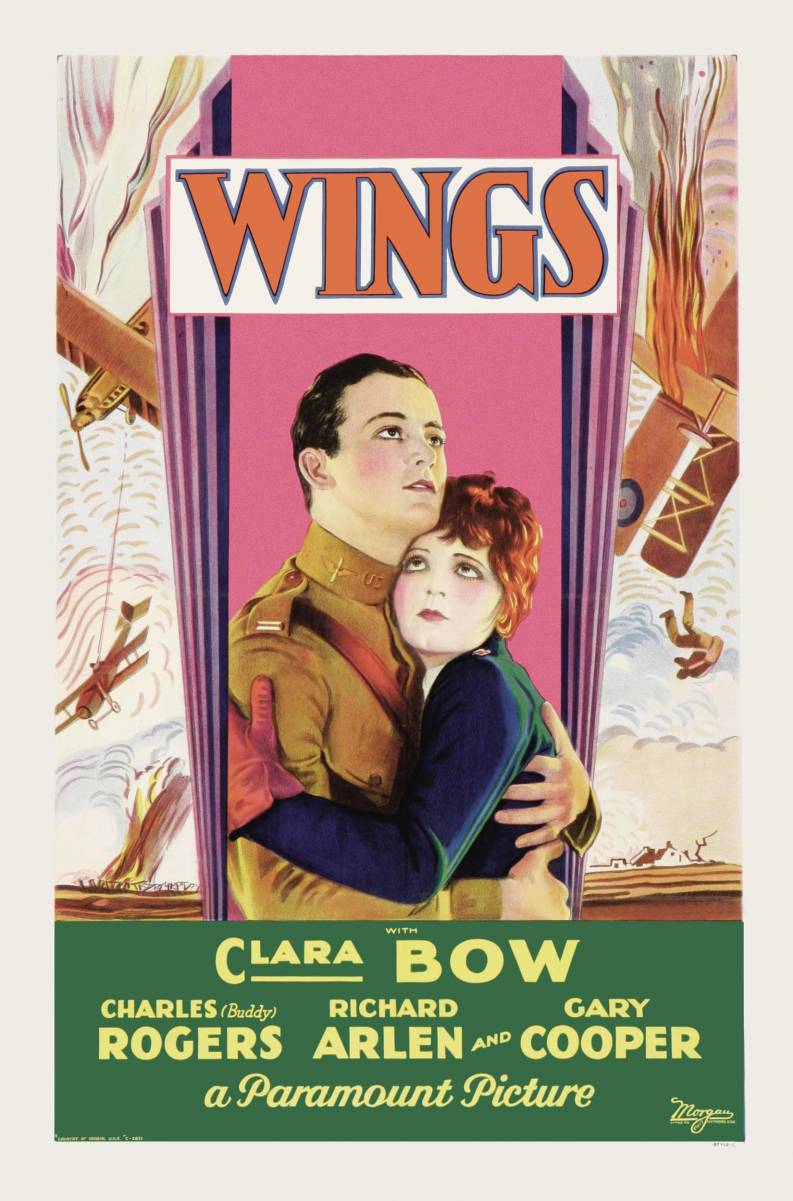
A Paramount Famous Lasky Corporation
Production, distributed by Paramount Pictures.
Wings
(1927) is a pretty significant film historically. It’s the first ever Best
Picture winner and, prior to this year, was the only silent film to ever win
that same Oscar. It features the first same-sex kiss on film and is one of the
first films to show nudity (this being Clara Bow’s rather lovely top half). In
this way, it’s a remarkable piece of cinema.
The story
though is not exceptional. It’s about two young men’s journey into becoming
fighter pilots during the First World War. There’s a subplot or two – mostly
romantic. The two men are competing initially over the same woman, Sylvia
(Jobyna Ralston), and through a mishap she ends up declaring herself to the
wrong one, Jack (Charles ‘Buddy’ Rogers), instead of the one she actually
loves, David (Richard Arlen). At the same time, Jack’s neighbour, Mary (played
wonderfully by original ‘it-girl’, Clara Bow) struggles with getting Jack to
see her romantically, and ends up following him out to war as an ambulance
driver.
The first
thing to know about Wings is that
it’s a long film. It stands at almost
two and a half hours and feels every bit as long as that. There’s a scene
mid-way through where Jack gets pretty wasted and the film kind of goes on a
tangent about bubbles. It’s weird (I mean,
really). The film as well seems to jump between exceptionally sombre
melodrama, slapstick and long fight scenes, in other words, a lot of chest
clutching and a lot of mishaps – including the aforementioned topless Clara Bow
scene which, whilst you don’t actually see a whole lot of anything (at least
not by today’s standards), feels like a direct draw on her sex-symbol status.

For me
though, the film’s remarkabilities stem from some solid performances by Bow and
Arlen and a wonderful cameo from a future movie star in Gary Cooper, but mostly
with the production values of the film. At 84 years old, the flight scenes are
still impressive, the cinematography expansive and the battles tense.
I didn’t love this film, honestly. There were parts of it I loved
– Mary’s decision to enter the war and then rescuing Jack from expulsion at her
own expense was great, the climactic flight scenes were exciting and David and
Jack’s reunion at the end is moving to say the very least. That said, there are
a lot of other things happening. The love triangle (square?) feels tacked on,
with next to no closure happening with poor Sylvia (who is grossly underused),
the male-bonding is drawn out and the film is just long and doesn’t necessarily always manage to keep you there with
it. It’s a solid film though, and as the original Oscar winner, it’s worth the
watch.
Rating: 7/10
Director:
William A. Wellman
Writers:
John Monk Saunders, Hope Loring & Louis D. Lighton
Producer:
BP Schulberg
Cast:
Clara Bow, Charles ‘Buddy’ Rogers & Richard Arlen
Nominations: Best Effects, engineering effects (winner)
& Best Picture, Production (winner)
Category 1927, 7, BW, Drama, Nomination:Best Effects, Nomination:Best Picture, Oscars01, Silent, Won:Best Effects, Won:Best Picture, WWI
About Me

- owlish
- Sophie Overett is a 22-year-old writer from Brisbane, Australia. She has a propensity for thermal singlets, white wine and making bios sound like terrible dating profiles. Her work has been published in Voiceworks and Writing Queensland. She’s also a fortnightly online columnist for Lip Mag where she writes about representations of women on TV. She has two cats and a blog. You should probably check out that last one.